








All Courses

.NET Full Stack Developer Training – Master Frontend, Backend & Cloud Development

Master the complete software development lifecycle within the Microsoft ecosystem with our premier .NET Full Stack Developer Training. This immersive program is engineered to build your expertise across both frontend and backend development. You will gain proficiency in backend engineering with C# Programming, ASP.NET, and the MVC architectural pattern, while mastering client-side development with HTML, CSS, JavaScript, and React. The curriculum provides deep, hands-on experience in Database Integration using Entity Framework and SQL Server. This course will teach you to build, deploy, and manage scalable, modern web applications, preparing you for high-impact roles like .NET Full Stack Developer, Software Engineer, and Web Developer. Upon completion, you will earn a recognized .NET Full Stack Developer Certification, validating your skills and opening doors to premier career opportunities in the global IT industry.

.NET Full Stack Developer Training – Master Frontend, Backend & Cloud Development
A Comprehensive Full-Stack Curriculum
  • Master Modern Frontend Development: Build dynamic, responsive, and interactive user interfaces using core web technologies like HTML, CSS, and JavaScript, along with the industry-leading library, React.
  • Engineer Robust Backend Systems with .NET: Develop scalable, high-performance, and secure server-side applications using C#, ASP.NET, and the MVC architectural pattern.
  • Achieve Seamless Database Integration: Gain proficiency in designing and managing data persistence layers with Entity Framework and SQL Server for optimal performance and reliability.
  • Master Cloud-Native Deployment: Learn to deploy, manage, and scale your applications on leading cloud platforms like Microsoft Azure, preparing you for modern DevOps workflows.
  • Hands-On, Project-Based Learning: Solidify your skills and build a professional portfolio by working on real-world projects, from initial concept to a complete, deployed Enterprise Application.
  • Earn Your Industry-Recognized Certification: Upon successful completion of the program, you will receive a .NET Full Stack Developer Certification, validating your expertise to employers.
The TechnoPaat® Advantage: Your Partner in Success
  • Learn from Industry Experts: Our trainers are seasoned professionals with extensive real-world experience in enterprise .NET Development and modern Full Stack Architecture.
  • Practical, Project-Driven Curriculum: Move beyond theory with a hands-on curriculum focused on practical projects and case studies that mirror real-world challenges.
  • Flexible and Accessible Learning: Choose a learning path that fits your schedule with flexible online and offline training options.
  • Dedicated Career and Placement Support: We provide comprehensive placement assistance, from resume building to interview preparation, to help you secure top roles like .NET Full Stack Developer and Software Engineer.
  • Continuous Learning and Support: Benefit from lifetime access to course materials and our ongoing support community.
Who Will Benefit from This Program?
  • Aspiring Developers and Recent Graduates: Individuals looking to launch a career in software engineering with a comprehensive and in-demand skill set within the Microsoft ecosystem.
  • Current IT Professionals and Software Engineers: Professionals seeking to upskill from specialized roles to a more versatile .NET Full Stack Development profile.
  • Career Changers: Anyone with a passion for technology aiming to master C#, ASP.NET, React, and Cloud Deployment for building modern applications.
Launch Your Career in High-Demand Roles

Completing this training will prepare you for a variety of high-impact and lucrative roles in the tech industry, including:

  • .NET Full Stack Developer: An all-rounder who can build and manage every part of a web application, from the user interface to the database.
  • Software Engineer: A core engineer who designs and builds scalable, enterprise-grade software solutions using .NET technologies.
  • Cloud Developer: A specialist focused on deploying, managing, and scaling applications on cloud platforms like Microsoft Azure.
  • Backend Developer: A specialist focused on creating the server-side logic, APIs, and database interactions that power applications.
Transform Your Career Today!

Enroll in our .NET Full Stack Developer Training to become a highly skilled and versatile developer. Gain the expertise to build, deploy, and manage complete, modern web applications, and unlock a world of exciting career opportunities in the global IT industry.

Module-1 .NET Introduction
  • Differences between Programming Languages
  • Platform Dependency Vs Platform Independency
  • .NET Languages & Compilers
  • CIL/MSIL code
  • Language Interoperability
Module-2 .NET Runtime
  • .NET Framework
  • .NET Core, .NET 5, and .NET 6
  • Architecture of .NET Runtime
  • Managed and Un-Managed Code
  • CLI Specifications
  • Versions of .NET Runtime
  • .NET Class Libraries (FCL & CORE FX)
Module-3 CLR
  • Security Manager
  • JIT Compiler
  • Garbage Collector
Module-4 Introduction to C#
  • History of C#
  • Versions and Features
  • Procedural Programming Approach
  • Object Oriented Programming Approach
  • Structure of a program in C
  • Structure of a program in C++
  • Structure of a program in Java
  • Structure of a program in C#
Module-5 Writing the 1st Program using C#
  • Rules to be followed
  • Saving the C# code in Notepad
  • Compiling C# Programs thru Developer Command Prompt
  • Executing compiled code thru Developer Command Prompt
Module-6 C# Data Types
  • Integer Types
  • Float, Double, Decimal Types
  • Boolean Type
  • DateTime Type
  • GUID Type
  • Char & String Types
  • Object Type
Module-7 Variables & Fields
  • Syntax of Variable & Field Declarations
  • Value Types Vs Reference Types
  • Nullable Value Types
  • Implicitly Typed Variables
  • Dynamic Type
  • Boxing Vs Un-Boxing
Module-8 Conditional Statements
  • Conditional Branching
  • Conditional Looping
  • Jump Statements
Module-9 Arrays
  • Single Dimensional Arrays
  • Array Class
  • Two Dimensional Arrays
  • Jagged Arrays
  • Implicitly Typed Arrays
  • Command Line Arguments
Module-10 Working with Visual Studio
  • Versions of Visual Studio IDE
  • Project Templates
  • Item Templates
  • Solution Explorer
  • Compilation
  • Execution
Module-11 Encapsulation
  • Sub Programs
  • Method Syntax
  • Parameter less Methods
  • Parameterized Methods
  • Non-Value Returning Methods
  • Value Returning Methods
  • In, Out and InOut Parameters
  • Params Keyword
  • Default Valued Parameters
  • Instance Creation
  • Difference between Instance, Variable & Reference of a class
  • De-referencing the instance of class
  • Multiple instances of a class
  • Constructors
  • Static Keyword
  • Case Study
Module-12 Inheritance
  • Implementation
  • Accessing parent members from child class
  • Creating parent class Reference by using child class Instance
  • Creating child class Reference by using parent class Reference
  • Default parent class
  • Types of Inheritance
  • Passing values to parent class constructor using child class instance
  • Case Study
Module-13 Polymorphism
  • Method Overloading
  • Inheritance based Overloading
  • Method Overriding
  • Hiding/Shadowing
  • Constructor Overloading
  • Operator Overloading
  • Types of Polymorphism
  • Sealed Classes & Methods
Module-14 Abstract Classes & Methods
  • Abstract methods & classes declaration
  • Need and advantages of Abstract Classes
  • Case Study
Module-15 Interface
  • Need of an Interface
  • Multiple Inheritance with Interfaces and Case Study
Module-16 Structure
  • Declaration and Implementation of a Structure
  • Differences between Structure and Class
Module-17 Extension Methods
  • Need and advantages of Extension Methods
  • Adding extension methods to user-defined and pre-defined types
Module-18 Solution & Projects
  • Application Architecture in Real-time Applications
  • Hierarchy of solutions and projects
  • Organizing solutions by adding new and existing projects
  • Project compilation and Assemblies
Module-19 Assemblies
  • .dll Assemblies
  • .exe Assemblies
  • Difference between assemblies
  • .NET Framework, .NET Core and .NET 5 Assembly organization
Module-20 Access Specifiers
  • Need and use of Access Specifiers
  • Types of access specifiers and their scope.
Module-21 Language Interoperability
  • What is Language Interoperability
  • Consuming C# Assemblies in VB Projects
  • Consuming VB Assemblies in C# Projects
Module-22 Miscellaneous members of a class
  • Finalizers
  • Properties
  • Indexers
  • Deconstructors
Module-23 Enum Type
  • What is an Enum
  • Definition and Consumption of Enums
Module-24 Exceptions & Exception Handling
  • What is an Exception
  • Exception class hierarchy
  • Need of Exception Handling
  • Try, Catch & Finally
  • Throwing Exceptions
  • System Exceptions
  • Application Exceptions
  • User-defined Exception Class
Module-25 Delegate Type
  • What is a delegate and where we use?
  • Defining delegates
  • Multicast Delegates
  • Anonymous Methods
  • Lambda Expressions
  • Expression bodied Members
Module-26 Miscellaneous Concepts
  • Anonymous Types
  • Partial Classes
  • Partial Methods
Module-27 Collections
  • Stack
  • Queue
  • Array List
  • Hash Table
  • Generics & Generic Collections
  • List, Dictionary, and other Collection classes
Module-28 LINQ
  • What is LINQ
  • LINQ Vs SQL, LINQ to Objects, LINQ to Databases, LINQ to XML
  • Implementing LINQ on Arrays, Collections & Objects
Module-29 Windows Programming
  • Introduction to GUI Programming
  • Controls – Properties, Methods and Events
  • Working with Form Control
  • Delegates, Events and Event Handlers
  • Button, TextBox, Radio Button and CheckBox Controls
  • Combo Box, ListBox and Checked ListBox Controls
  • Dialog Controls – Color Dialog, Font Dialog, Open File Dialog, Save File Dialog and Folder Browser Dialog
  • Image and Timer Controls
  • Creating Menu’s and Menu Item’s
  • MDI and Layout’s
  • User Controls
Module-30 Accessing Data with ADO.NET
  • ODBC Drivers
  • OLEDB and Framework Providers
  • ADO Vs ADO.NET
  • Introduction To ADO.NET Technology
  • Communication with Data Sources
  • Connected Architecture
  • Disconnected Architecture
  • DataReader Vs DataSet
  • Connection Strings and Configuration Files
  • DataTable, DataRow, DataColumn, DataView and DataRelation Classes
  • Working with Stored Procedures
  • Data Binding with Data Source Controls – GridView and DataGrid
Module-31 Assemblies
  • Private Assemblies
  • Shared Assemblies
  • Global Assembly Cache
  • Versioning of Assemblies
  • Contents of an Assembly file
Module-32 Task Parallel Library (TPL)
  • Task Vs Threads
  • Asynchronous Programming
  • Calling methods with Tasks
  • Thread Synchronization
  • Data Parallelism with Parallel.For and Parallel.ForEach
  • Task chaining using continuation Tasks
  • Task cancellation using cancellation tokens
  • Async and Await

Module-1 Introduction to Web Applications
  • Windows Applications Vs Web Applications Vs Distributed Applications
  • ASP.NET Vs ASP.NET Core
  • Client/Server Architecture Application
  • What are Client and Server
  • Role of Web Server
  • IIS (Internet Information Services)
  • Creating a new Website on IIS
Module-2 ASP .NET Technology
  • Classical ASP
  • Drawback Of classical ASP
  • Evolution Of ASP.NET - Web Forms
  • Evolution Of ASP.NET - MVC
  • Introduction to MVC
  • Introduction to Design Patterns
  • Architecture Patterns
Module-3 Intro to MVC
  • ASP.NET Web Forms (Vs) ASP.NET MVC
  • List of Versions of ASP.NET MVC
  • MVC Architecture, what is MVC?
  • What is Controller and Action Method
  • What is View & What is Model
  • Request Flow in ASP.NET MVC

Module-1 Project Creation
  • Creating New Project in Visual Studio
  • Overview of Folders and files of MVC project
Module-2 Controllers
  • Introduction
  • Creating Controllers Manually and by using Scaffolding
  • Action Methods in Controllers
  • Parameters to Action methods
Module-3 URL Routing
  • Overview
  • Need of URL Routing, Parameters in URL
  • Default Parameter Values
  • Literals in URL
Module-4 Views
  • Introduction
  • Action Results and various types of Action Results
  • Action Methods returning Action Results
  • Creating a Razor View
  • Shared Views
  • View Engines
  • ASPX View Engine Vs Razor View Engines
  • Razor Programming
Module-5 Passing Data from Controller to View
  • View Data
  • View Bag
  • Temp Data
  • Sessions
  • Anonymous Methods
  • Strongly Typed Models
Module-6 UI Designing
  • With HTML Controls
  • With HTML Helpers
  • With Strongly Typed HTML Helpers
Module-7 Partial Views
  • Need of Partial Views
  • Development and Consumption of Partial Views
  • Html.Partial
  • Html.RenderPartial
  • Html.RenderAction
Module-8 Layout Views
  • Introduction and need of Layout Views
  • Default Layout View (_Layout.cshtml)
  • Creating custom Layout Views
  • Layout Views with Sections
  • Html.RenderSection()
  • _ViewStart.cshtml
  • Overriding _ViewStart.cshtml
Module-9 Bundling And Minification
  • Need of Minification and Bundling
  • BundleConfig.cs
  • ScriptBundles and StyleBundles
  • Importing ScriptBundles and StyleBundles
  • Creating and consuming custom bundles
Module-10 Areas in MVC
  • What is an Area in MVC Application?
  • Need and creation of MVC Area
  • Area Registration and Configuration
Module-11 Data Annotations and Validations
  • Introduction
  • Model level validations (vs) View level validations
  • Importing jQuery Validation Plug in
  • [Required], [RegularExpression]
  • [Range], [StringLength], [Compare]
  • [Remote], ModelState.IsValid, Custom Validations
  • [Display], [Datatype], [DisplayFormat], [ScaffoldColumn]
Module-12 LINQ to SQL
  • Introduction to LINQ
  • What is LINQ to SQL
  • Performing CRUD Operation using LINQ to SQL
Module-13 ADO.NET Entity Framework (EF)
  • Introduction to Entity Framework
  • Various Approaches in EF
  • Understanding DbContext and DbSet
  • Entity Framework DB First
  • Entity Framework Code First
  • Entity Framework Model First
Module-14 Scaffold Templates
  • Need of Scaffolding
  • Creating controllers and views using scaffold
  • Understanding Index, Details, Create, Edit, Delete action methods and views
Module-15 Filters
  • Introduction to Filters
  • ChildActionOnly, OutputCache, ValidateInput
  • ValidateAntiForgeryToken, HandleError
  • Action Filters, Result Filters, Authorization Filters
  • Exception Filters, Custom Filters
  • Authentication and Authorization
  • Types of Authentications
  • AllowAnonymous
Module-16 JQuery and Ajax in MVC
  • Introduction and need of JQuery in MVC
  • Importing/Updating JQuery plug in and Demos
  • Implementing Auto fill Textbox's using JQuery AJAX
  • JTable and MVC Grid Controls
Module-17 Web API
  • Introduction to distributed applications
  • Web Services Vs WCF Vs Web API
  • Understanding HTTP Methods (GET, POST, PUT, DELETE)
  • Creating API Controller and API configuration
  • Calling Web API from JQuery
  • CRUD operations using JQuery AJAX with Web API
  • Enabling CORS
  • Consuming Web API from MVC Project
Module-18 Developing Single Page Applications
  • What is SPA
  • Need of SPA and Getting started
  • Angular Integration

Module-1 Introduction to .NET CORE
  • What is .NET CORE
  • What’s new in.NET core
  • ASP.NET core
  • .NET Core Vs ASP.NET Core
Module-2 ASP.NET CORE MVC Applications
  • Introduction
  • Setting up a new project
  • Command line tools and code
  • ASP.NET Core MVC project structure
  • Program and Stratup Classes
  • Main method in ASP.NET Core Applications
Module-3 Startup and Middleware’s
  • Introduction
  • How Middleware Works
  • Configure and Configure Services Methods
  • Exception Handling Middleware
  • Routing Middleware
  • Static Files Middleware
  • Setting up ASP.NET MVC Middleware
Module-4 Hosting Models
  • What are Hosting Models
  • Types of Hosting Models
  • Kestrel Web Server
  • Reverse Proxy Servers
Module-5 Controllers in MVC Framework
  • Introduction
  • MVC design pattern
  • Routing
Module-6 Views in MVC Framework
  • Creating Simple Views
  • Tag Helpers for creating Views
  • Built-in Tag Helpers
  • Custom Tag Helpers
Module-7 Models in MVC Framework
  • Introduction
  • Models and Views
  • Entity Framework CORE
  • Introduction
  • Installing EF Core
  • EF Core Architecture and Libraries
  • Creating and Implementing DB Context
  • Configuring EF Services
  • Entity Framework Migrations
  • Various Approaches in EF (DB First and Code First)
  • Creating CRUD Application in MVC Core using DB First
  • Creating CRUD Application in MVC Core using Code First
  • Dependency Injection Introduction
  • Dependency Injection Containers
  • Integrated support of Dependency Injection in ASP.NET Core
  • Implementing Dependency Injection in MVC Core Applications
Module-8 Error Handling In MVC Core Applications
  • Handling Client Errors
  • Handling Server Errors
Module-9 ASP.NET CORE Identity
  • Introduction to Identity Framework
  • Authentication Services and Middleware
  • Identity in ASP.NET Core MVC
  • Open Authentication
  • Authorization
Module-10 WEB API Core
  • Creating a WEB API Core Service
  • Testing WEB API Core Services using Swagger
  • Implementing Dependency Injection in WEB API Core
  • Consuming WEB API Core Service in MVC CORE using JQUERY
  • Consuming WEB API Core Service in MVC CORE using C#
Module-11 Publish/Hosing and MVC Core Application
  • What is Publish/Host
  • Types of Publishing/Hosting options
  • File System Vs Web Deploy Vs App Service
  • Hosting MVC Core Application on Microsoft Azure
  • Summarizing the whole proces

Send Me Message

Trust & Validation

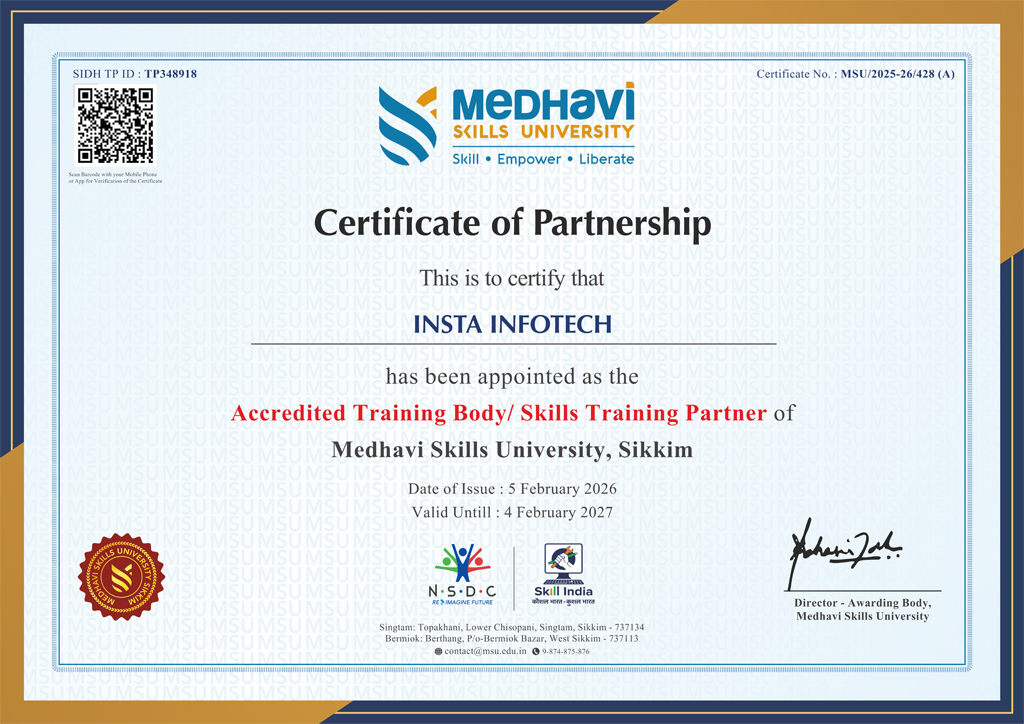
UGC-Recognized Skilled Qualifications for the Modern Global Workforce

Discover Your Language Learning Goals

Whether you’re learning for travel, work, or personal/ professional growth, we’ll help you identify your objectives and match you with the perfect language course to meet your goals.


Choose the Right language Course for You

From beginner basics to advanced fluency, we offer customized programs designed to suit your learning pace and style. Explore group classes, private lessons, or online options.

Learn with Experts and Advanced Tools

Experience interactive lessons led by certified instructors using cutting-edge techniques and technology. Our immersive approach ensures rapid progress and lasting confidence.

Practice, Progress, and Achieve Fluency

Engage in real-world practice, track your progress with regular assessments, and celebrate milestones as you master your chosen language. Success is within reach!

The Ultimate IT Training: From Basics to Breakthroughs Join Our free WebinarPOWER BI

Are you ready to future-proof your IT career and stay ahead in the fast-evolving tech landscape? Join our exclusive webinar, Transform Your IT Career!


20-SEPTEMBER, 2025 - 11- AM

Free Webinar

Register Now
The Ultimate IT Training: From Basics to Breakthroughs Join Our free Webinar
Specializations

Skilled, Qualification, Certification

Discover Your Language Learning Goals

Discover Your Language Learning Goals

Whether you’re learning for travel, work, or personal/ professional growth, we’ll help you identify your objectives and match you with the perfect language course to meet your goals.

Choose the Right language Course for You

Choose the Right language Course for You

From beginner basics to advanced fluency, we offer customized programs designed to suit your learning pace and style. Explore group classes, private lessons, or online options.

Learn with Experts and Advanced Tools

Learn with Experts and Advanced Tools

Experience interactive lessons led by certified instructors using cutting-edge techniques and technology. Our immersive approach ensures rapid progress and lasting confidence.

Practice, Progress, and Achieve Fluency

Practice, Progress, and Achieve Fluency

Engage in real-world practice, track your progress with regular assessments, and celebrate milestones as you master your chosen language. Success is within reach!


Our Blogs

Latest Blog Updates

Transform Your Career with Tech Lingua - Premier IT Training Institute

Join Tech Lingua for cutting-edge IT training programs designed to boost your skills and career prospects. Offering expert-led Courses in Software Development, Data Science, Cybersecurity, and more.

00+

Trained Students

00+

Years of Experience

00+

Countries Represented

00x7

Support

TechnoPaat

What We Offer

At TechnoPaat, we specialize in a wide array of courses across domains like:

Programming Languages: Java, Python, C++, .NET, and more. Data Science & Analytics: Machine Learning, AI, Big Data. Cloud Computing & DevOps: AWS, Azure, Docker, Kubernetes. Cybersecurity: Ethical Hacking, Network Security. Digital Marketing: SEO, Social Media, Content Marketing. Database Management: SQL, PL/SQL, MongoDB, Oracle.

Call For Inquiry

011 42639862

+91-99 11 33 7041

Send Us Email

info@technopaat.com

Enquire Now
Our learners work at