









All Courses

Oracle DBA Training Institute

An Oracle Database Administrator (DBA) is a professional responsible for the management, integrity, and security of an organization's data using Oracle Database, a multi-model relational database management system developed by Oracle Corporation. This role requires deep expertise in Database Management Systems (DBMS) to effectively define, create, maintain, back up, and secure an organization's databases, ensuring data is always available and protected.

Oracle DBA Training Institute
The Role of the Oracle Database Administrator (DBA)

An Oracle Database Administrator (DBA) is a highly skilled professional responsible for the performance, integrity, and security of a company's data within the Oracle Database system, a multi-model relational database management system (RDBMS) developed by Oracle Corporation. A DBA uses deep expertise in database management to define, create, maintain, back up, and secure an organization's critical databases.

Core Responsibilities of an Oracle DBA

The role of an Oracle DBA encompasses a wide range of critical tasks, including:

  • Installation and Maintenance: Installing, configuring, and upgrading Oracle database software, application tools, and patches.
  • Database Architecture: Creating primary database storage structures (tablespaces) and objects (tables, views, indexes) based on application designs and requirements.
  • Security and Access Control: Enrolling users, maintaining system security, and controlling user access to ensure data is protected and compliant.
  • Performance Monitoring and Optimization: Continuously monitoring database performance and optimizing queries, indexes, and configurations to ensure efficiency and speed.
  • Backup and Recovery Strategy: Designing and implementing robust backup and recovery plans to protect against data loss and ensure business continuity. This includes backing up, restoring, exporting, and importing data.
  • Storage Management: Allocating system storage and planning for future capacity requirements to ensure the database remains scalable.
  • Troubleshooting and Support: Providing expert technical support to application development teams and troubleshooting any issues related to the database, applications, or development tools.
  • Data Integrity: Administering all database objects and enforcing constraints to ensure the integrity and consistency of the data.

Introduction to DBMS
  • Approach to Data Management
  • Introduction to prerequisites, File Settings and File-system
  • Review of Database Management Terminology
  • Database Models
  • Hierarchal Model
  • Network Model
  • Relational Model
Introduction to RDBMS
  • Features & Advantages of RDBMS and DBMS
  • The 12 rules (E.F Codd's Rules -RDBMS)
  • Need for Database Design
  • Support of Normalization Process for Data Management
  • Client-Server Technology
  • Oracle Versions
  • About SQL&SQL*PLUS
Introduction To ORACLE
  • Difference between Oracle Old and latest versions
  • Installation of Oracle Software
  • About SQL*Plus and use of developer tool
  • Data types in Oracle
  • Operators in Oracle
  • Understanding Schema design and objects
ORACLE Sub Language Commands
  • Data Definition Language (DDL)
  • Data Retrieval Language (DRL)
  • Data Manipulation Language (DML)
  • Transaction Control Language (TCL)
  • Database Security and Privileges (DCL)
Working With DDL Commands in ORACLE
  • Table creation using CREATE statement
  • Creating table from another table
  • Dropping a table using DROP command
  • Altering the column of a table
  • Renaming an entire table
  • Using truncate command
  • Difference between Delete and Truncate command
Working With DML Commands in ORACLE
  • Table creation using CREATE statement
  • Creating table from another table
  • Dropping a table using DROP command
  • Altering the column of a table
  • Renaming an entire table
  • Using truncate command
  • Difference between Delete and Truncate command
Working with DCL, TCL Commands in ORACLE
  • Grant, Revoke
  • Page No
  • Commit, Rollback, Save point
  • SQL Editor Commands
  • SQL Environment settings
Managing Users and Securing Database
  • Establishing Security Policy on a Database
  • Privileges and Roles
  • Managing oracle database users
  • How to create a new database user
  • Auditing Database activities
  • Predefined oracle database accounts
Introduction to SQL Database Object in ORACLE
  • Oracle Pre Defined Datatypes
  • DQL-SELECT Statements using WHERE Clause
  • Comparison and Conditional Operators Arithmetic and Logical Operators
  • Special Operators - IN (NOT IN), BETWEEN (NOT BETWEEN), LIKE (NOT LIKE), IS NULL (IS NOT NULL)
  • Working with DML, DRL Commands.
Working with Integrity Constraints in ORACLE
  • Importance of Data Integrity
  • How to add constraints to an existing table?
  • NOT NULL constraint
  • UNIQUE constraint + PRIMARY KEY constraint
  • FOREIGN KEY constraint
  • CHECK constraint
  • Applying DEFAULT option to columns
  • How to enable and disable constraints?
  • How to get information about constraints?
Data Retrieval Techniques in ORACLE
  • How to use select statement in different ways to retrieve records?
  • Working with Column and table alias
  • Data filtering and sorting with in single table
  • Clauses and its types in oracle
  • Where clause & Having clause & From clause
  • Group by clause, Order by clause
  • Constraint clause
Built-in Functions in ORACLE
  • How to use single row functions using dummy table?
  • Character Functions and String functions
  • Date functions
  • Mathematical functions
  • Conversion functions
  • Aggregate Functions
  • Special functions
  • Analytical functions
Set Operators in ORACLE
  • Working with set operator types
  • UNION and UNION ALL
  • INTERSECT
  • MINUS
Pseudo Columns in Oracle
  • Understanding Pseudo Columns in Oracle
  • Types of Pseudo Columns in Oracle
  • CURRVAL and NEXTVAL
  • LEVEL
  • ROWID
  • ROWNUM
Functions in PL/SQL in ORACLE
  • Difference between Procedures and Functions
  • How to create functions?
  • How to use inline functions?
  • Nested Functions
  • Using stored function in SQL statements
Querying Multiple Tables (Joins) in ORACLE
  • Understanding joins and its uses
  • Types of joins
  • Simple Join / Equi-join / Inner Join / Outer join
  • Left & Right outer join and Full outer join
  • Cross join
Sub Queries in ORACLE
  • Importance of sub queries
  • Using different types of sub queries
  • Single row sub queries and Multi row sub queries
  • Nested queries
  • Multi column sub queries
  • IN, ANY/SOME, ALL Operators in Sub Queries
  • Handling Data Retrieval with EXISTS and NOT EXISTS Operators
VIEWS in Oracle
  • Types of VIEWS
  • Relational Views and Object Views
  • Practical approach of SIMPLE VIEWS and COMPLEX VIEWS
  • Column definitions in VIEWS
  • Using VIEWS for DML Operations
  • Putting CHECK Constraint upon VIEWS
  • Creation of READ ONLY VIEWS
  • Understanding the IN LINE VIEWS
  • About Materialized Views
  • View Triggers
Triggers in PL/SQL in ORACLE
  • How to create triggers?
  • Benefits of trigger
  • Using DML trigger & DDL trigger
  • How to audit database using triggers?
  • What are database level trigger?
Creation Of Stored Procedures in ORACLE
  • Creating Procedures in PL/SQL
  • IN parameter / OUT parameter / INOUT parameter
  • Procedure with Cursors
  • Dropping a Procedure
Creating and Using Cursors in ORACLE
  • How to create cursors in PL/SQL
  • How to create explicit cursor?
  • What are cursor parameters?
  • How to use for update clause?
  • How to use implicit cursors?
Introduction to PL/SQL (Procedural Language Extension to SQL)
  • Introduction & advantages of PL/SQL
  • Datatypes, Variable and Constants in PL/SQL
  • Conditional and Unconditional Statements
  • Simple if, if... else, nested if..else, if..else Ladder
  • Selection Case, Simple Case, GOTO Label and EXIT
  • Simple LOOP, WHILE LOOP, FOR LOOP and NESTED LOOPS
  • SQL within PL/SQL
Implementing OOPS Technology in ORACLE
  • What is Object Technology?
  • Creation of classes and objects
  • Inserting rows in a table using Objects
  • Retrieving data from Object-based Tables
  • Calling a Method
Design Of Schema Objects in ORACLE
  • Creating and working with Views
  • Working with Synonyms
  • Creating Index and clusters
  • Working with in materialized view
  • Understanding sequences and its types
File Input/Output in ORACLE
  • PL/SQL file I/O (Input/Output)
  • SQL* Loader Architecture
  • .txt to base table
Procedure in Oracle
  • Create procedure
  • Declare Values & Variables in Procedure.
  • Call & Invoke procedure
Creating & Using Packages in ORACLE
  • What is a Package?
  • Reasons to use packages
  • What is package specification?
  • What is package body?
  • How to initialize instantiated package?
  • Creating PACKAGE Specification and PACKAGE Body
Collections In PL/SQL in ORACLE
  • What is collection?
  • How to use arrays?
  • Using nested tables
  • How to use index by value?
  • Listing types of collection methods.
Exception Handling in ORACLE
  • What is an Exception and Types of exceptions?
  • Handling system defined exceptions
  • Handling user defined exceptions?
  • RAISE_APPLICATION_ERROR
  • SQL Error Code Values
Advanced Features in ORACLE LATEST VERSIONS
  • Introduction to Oracle Database Architecture & its Type
  • Merge statement
  • Temporary Tables/Global Tables
  • New Function EXTRACT()
  • About Flash Back Queries
  • New data types, Flash back Command
  • Regular expressions, DML Error Logging
  • Types of Table spaces
Security and Locks in ORACLE LATESET VERSIONS.
  • Row level Locks
  • Table Level Locks
  • Use of commit and rollback
  • Use of save-point and set transaction
  • How to give system privileges to an user?
  • How to invoke and revoke object privileges?
  • How to create users and roles?

Send Me Message

Trust & Validation

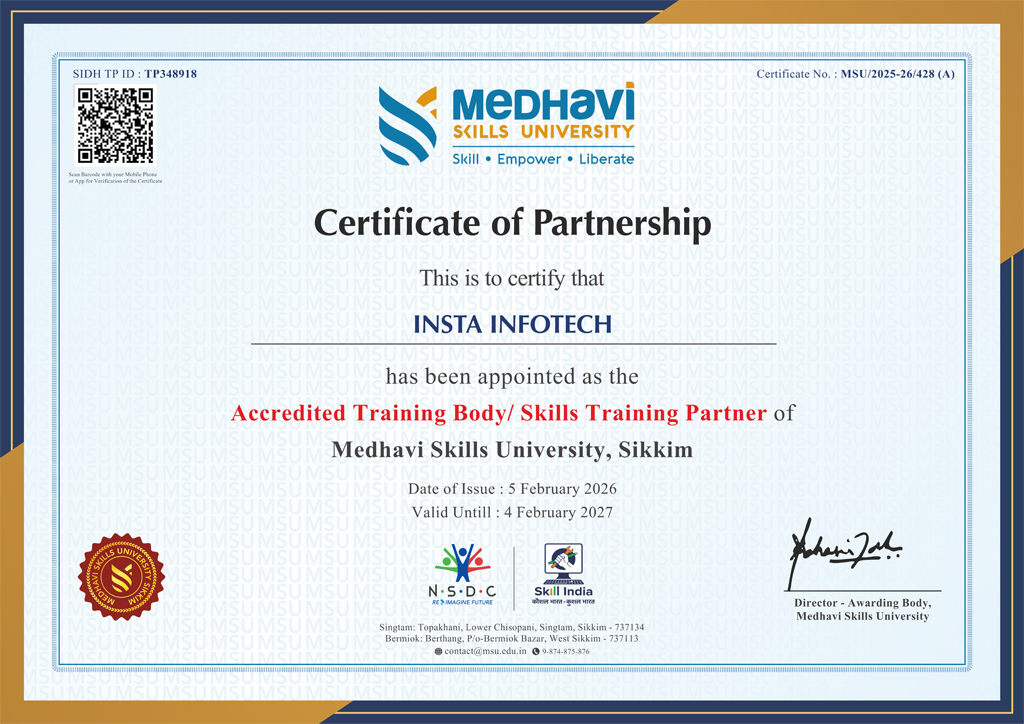
UGC-Recognized Skilled Qualifications for the Modern Global Workforce

Discover Your Language Learning Goals

Whether you’re learning for travel, work, or personal/ professional growth, we’ll help you identify your objectives and match you with the perfect language course to meet your goals.


Choose the Right language Course for You

From beginner basics to advanced fluency, we offer customized programs designed to suit your learning pace and style. Explore group classes, private lessons, or online options.

Learn with Experts and Advanced Tools

Experience interactive lessons led by certified instructors using cutting-edge techniques and technology. Our immersive approach ensures rapid progress and lasting confidence.

Practice, Progress, and Achieve Fluency

Engage in real-world practice, track your progress with regular assessments, and celebrate milestones as you master your chosen language. Success is within reach!

The Ultimate IT Training: From Basics to Breakthroughs Join Our free WebinarPOWER BI

Are you ready to future-proof your IT career and stay ahead in the fast-evolving tech landscape? Join our exclusive webinar, Transform Your IT Career!


20-SEPTEMBER, 2025 - 11- AM

Free Webinar

Register Now
The Ultimate IT Training: From Basics to Breakthroughs Join Our free Webinar
Specializations

Skilled, Qualification, Certification

Discover Your Language Learning Goals

Discover Your Language Learning Goals

Whether you’re learning for travel, work, or personal/ professional growth, we’ll help you identify your objectives and match you with the perfect language course to meet your goals.

Choose the Right language Course for You

Choose the Right language Course for You

From beginner basics to advanced fluency, we offer customized programs designed to suit your learning pace and style. Explore group classes, private lessons, or online options.

Learn with Experts and Advanced Tools

Learn with Experts and Advanced Tools

Experience interactive lessons led by certified instructors using cutting-edge techniques and technology. Our immersive approach ensures rapid progress and lasting confidence.

Practice, Progress, and Achieve Fluency

Practice, Progress, and Achieve Fluency

Engage in real-world practice, track your progress with regular assessments, and celebrate milestones as you master your chosen language. Success is within reach!


Our Blogs

Latest Blog Updates

Transform Your Career with Tech Lingua - Premier IT Training Institute

Join Tech Lingua for cutting-edge IT training programs designed to boost your skills and career prospects. Offering expert-led Courses in Software Development, Data Science, Cybersecurity, and more.

00+

Trained Students

00+

Years of Experience

00+

Countries Represented

00x7

Support

TechnoPaat

What We Offer

At TechnoPaat, we specialize in a wide array of courses across domains like:

Programming Languages: Java, Python, C++, .NET, and more. Data Science & Analytics: Machine Learning, AI, Big Data. Cloud Computing & DevOps: AWS, Azure, Docker, Kubernetes. Cybersecurity: Ethical Hacking, Network Security. Digital Marketing: SEO, Social Media, Content Marketing. Database Management: SQL, PL/SQL, MongoDB, Oracle.

Call For Inquiry

011 42639862

+91-99 11 33 7041

Send Us Email

info@technopaat.com

Enquire Now
Our learners work at